With input from the members of the Board of Reviewing Editors and editorial staff, Science Signaling puts the spotlight on the hottest signaling research of 2012. The connection between signaling and metabolism continues to be an important area. Signaling breakthroughs in cancer, immunology, developmental biology, neuroscience, and microbiology all made the list. Structural and molecular insights into signaling proteins and networks are also beginning to not only yield potential therapeutic targets but also lead to successful efforts between synthetic biologists and clinicians in the treatment of cancer.
Tuesday, January 1, 2013

The NaV1.7 sodium channel: from molecule to man
The voltage-gated sodium channel NaV1.7 is preferentially expressed in peripheral somatic and visceral sensory neurons, olfactory sensory neurons and sympathetic ganglion neurons. NaV1.7 accumulates at nerve fibre endings and amplifies small subthreshold depolarizations, poising it to act as a threshold channel that regulates excitability. Genetic and functional studies have added to the evidence that NaV1.7 is a major contributor to pain signalling in humans, and homology modelling based on crystal structures of ion channels suggests an atomic-level structural basis for the altered gating of mutant NaV1.7 that causes pain.
Sulayman D. Dib-Hajj, et al.

Friday, December 28, 2012
XMASS announced their solar axion limit
XMASS dark matter experiment in Japan announced their solar axion limit, using 6.7 days, total of 5.6 ton-days. Their limit below 1 keV axion mass is g_Ae < 5.4 × 10⁻¹¹ (90% C.L.).
http://arxiv.org/abs/1212.6153 (The final plot is given below.)
Their paper can be compared to the predicted sensitivity given by Arisaka Lab's analysis:

Thursday, December 27, 2012
Quantitative analysis of peptides and proteins in biomedicine by targeted mass spectrometry
Targeted mass spectrometry (MS) is becoming widely used in academia and in pharmaceutical and biotechnology industries for sensitive and quantitative detection of proteins, peptides and post-translational modifications. In Nature methods, Gillette and Carr describe the increasing importance of targeted MS technologies in clinical proteomics and the potential key roles these techniques will have in bridging biomedical discovery and clinical implementation.
Michael A Gillette & Steven A Carr

Michael A Gillette & Steven A Carr

All-in-one optogenetics
Scientists reverse engineer fluorescent proteins for light-mediated control.
Optogenetics is a young discipline that is coming on strong in fields such as neuroscience and protein signaling. It refers to the use of light-sensitive proteins to control cellular processes in living cells and organisms. Optogenetic tools can also be used to sense biological processes. Each of these applications has been performed with separate protein tools—until now. Michael Lin, at Stanford University, and his colleagues have adapted a fluorescent protein (FP) to act as a light switch for controlling protein interactions, creating a protein tool that can both mediate biological function and report its own activity.
Xin Zhou et al.
Optical Control of Protein Activity by Fluorescent Protein Domains
Science 9 November 2012: Vol. 338 no. 6108 pp. 810-814 DOI: 10.1126/science.1226854

Wednesday, December 26, 2012
A cellular mechanism for cortical associations: an organizing principle for the cerebral cortex
A basic feature of intelligent systems such as the cerebral cortex is the ability to freely associate aspects of perceived experience with an internal representation of the world and make predictions about the future. Here, a hypothesis is presented that the extraordinary performance of the cortex derives from an associative mechanism built in at the cellular level to the basic cortical neuronal unit: the pyramidal cell. The mechanism is robustly triggered by coincident input to opposite poles of the neuron, is exquisitely matched to the large- and fine-scale architecture of the cortex, and is tightly controlled by local microcircuits of inhibitory neurons targeting subcellular compartments. This article explores the experimental evidence and the implications for how the cortex operates.
Matthew Larkum
Trends in Neurosciences, 26 December 2012
10.1016/j.tins.2012.11.006


Matthew Larkum
Trends in Neurosciences, 26 December 2012
10.1016/j.tins.2012.11.006


Sunday, December 23, 2012
Neuronal reference frames for social decisions in primate frontal cortex
Steve Chang et. al. studied encoding of the outcomes of social decisions in three frontal cortical areas as monkeys performed a social reward allocation task. Orbitofrontal cortex neurons signaled received rewards, anterior cingulate (ACC) sulcus neurons signaled foregone rewards, and the ACC gyrus was involved in the computation of shared experience and social reward.
Nature Neuroscience (2012) doi:10.1038/nn.3287

Nature Neuroscience (2012) doi:10.1038/nn.3287

Closed-loop optogenetic control of thalamus as a tool for interrupting seizures after cortical injury
Cerebrocortical injuries such as stroke are a major source of disability. Maladaptive consequences can result from post-injury local reorganization of cortical circuits. For example, epilepsy is a common sequela of cortical stroke, but the mechanisms responsible for seizures following cortical injuries remain unknown. In addition to local reorganization, long-range, extra-cortical connections might be critical for seizure maintenance. In rats, researchers found that the thalamus, a structure that is remote from, but connected to, the injured cortex, was required to maintain cortical seizures. Thalamocortical neurons connected to the injured epileptic cortex underwent changes in HCN channel expression and became hyperexcitable. Targeting these neurons with a closed-loop optogenetic strategy revealed that reducing their activity in real-time was sufficient to immediately interrupt electrographic and behavioral seizures. This approach is of therapeutic interest for intractable epilepsy, as it spares cortical function between seizures, in contrast with existing treatments, such as surgical lesioning or drugs.
Lian Han et al.

Lian Han et al.

A subpopulation of nociceptors specifically linked to itch
A method for tagging single transcripts with two fluorescent markers can be used to study many aspects of gene expression, including intrinsic noise in transcription or polymerase dynamics at a single gene, report Singer and colleagues.
Lian Han et al.
Nature Neuroscience (2012) doi:10.1038/nn.3289

Lian Han et al.
Nature Neuroscience (2012) doi:10.1038/nn.3289

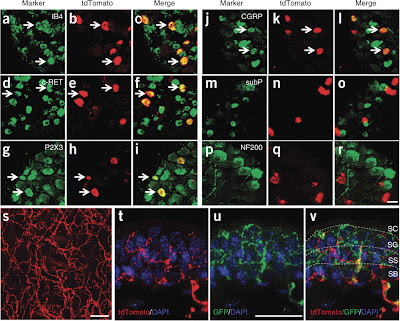
A subpopulation of nociceptors specifically linked to itch
Dorsal root ganglion neurons respond to both painful and itchy stimuli, but are there itch-specific neurons? Here the authors describe a group of MrgprA3-expressing neurons that innervate the superficial layers of the skin and selectively sense itch.
Lian Han et al.
Lian Han et al.
