Showing posts with label Dark Matter. Show all posts

Friday, December 28, 2012

XMASS announced their solar axion limit

XMASS dark matter experiment in Japan announced their solar axion limit, using 6.7 days, total of 5.6 ton-days.  Their limit below 1 keV axion mass is g_Ae < 5.4 × 10⁻¹¹ (90% C.L.). 
http://arxiv.org/abs/1212.6153 (The final plot is given below.)
Their paper can be compared to the predicted sensitivity given by Arisaka Lab's analysis:

Friday, December 21, 2012

Nine-Year WMAP results announced

The model fit implies that the age of the universe is 13.772+/-0.059 Gyr, and the fit Hubble constant is H0 = 69.32+/-0.80 km/s/Mpc. Inflation is also supported: the fluctuations are adiabatic, with Gaussian random phases; the detection of a deviation of the scalar spectral index from unity reported earlier by WMAP now has high statistical significance (n_s = 0.9608+/-0.0080); and the universe is close to flat/Euclidean, Omega_k = -0.0027 (+0.0039/-0.0038).   Overall, the WMAP mission has resulted in a reduction of the cosmological parameter volume by a factor of 68,000 for the standard six-parameter LCDM model, based on CMB data alone. 
http://arxiv.org/abs/1212.5225
http://arxiv.org/abs/1212.5226


Thursday, December 20, 2012

6th Symposium on Large TPCs at Paris on Dec 17-19, 2012

SIXTH SYMPOSIUM ON LARGE TPCs FOR LOW ENERGY RARE EVENT DETECTION
at PARIS 13ème, France on December 17-19, 2012
http://www-tpc-paris.cea.fr
Presentations are posted under "Slides".

Thursday, December 6, 2012

Arisaka's Physics Colloquium on Dark Matter

Katsushi Arisaka gave a Physics Colloquium at UCLA to review the status of dark matter researches. Presentation is available either as PDF or PPT files.

Friday, October 26, 2012

New South Pole Telescope shows Omaga = 1.006 +- 0.004

The South Pole Telescope published the new results.
Omega_K=-0.003+0.014-0.018. Using the SPT+WMAP7 data, the spectral index of scalar fluctuations tis ns=0.9623+/-0.0097 in the LCDM model, a 3.9sigma preference for a scale-dependent spectrum with ns<1.

Tuesday, October 16, 2012

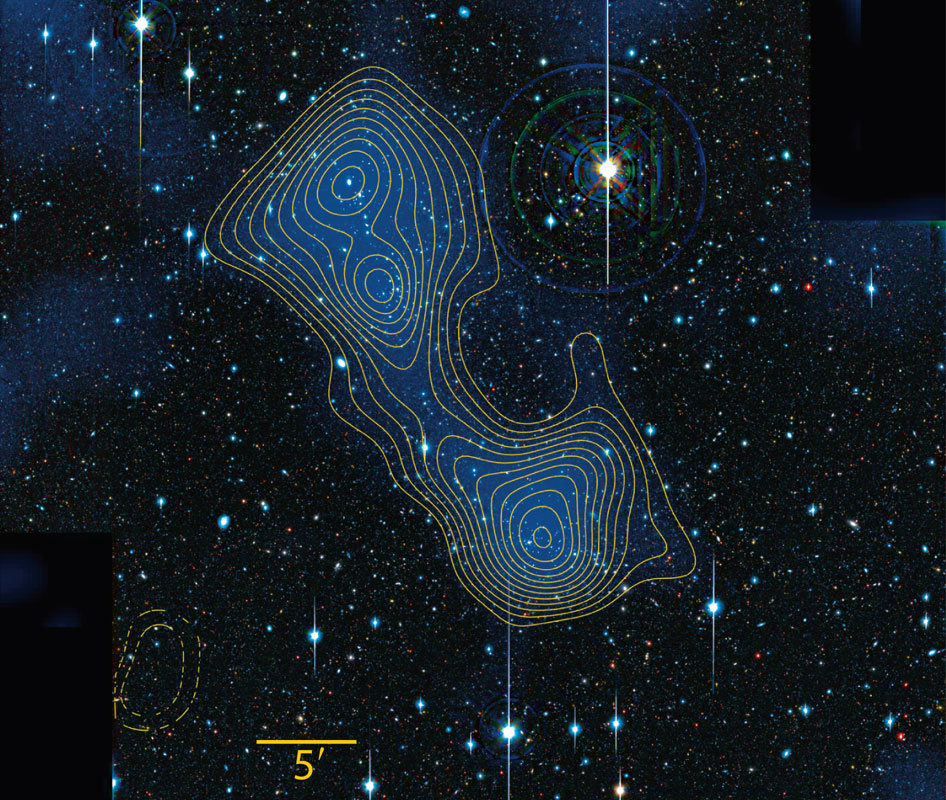
Dark Matter Filament Studied in 3-D for the First Time

Astronomers using the NASA/ESA Hubble Space Telescope have studied a giant filament of dark matter in 3D for the first time. Extending 60 million light-years from one of the most massive galaxy clusters known, the filament is part of the cosmic web that constitutes the large-scale structure of the Universe, and is a leftover of the very first moments after the Big Bang. If the high mass measured for the filament is representative of the rest of the Universe, then these structures may contain more than half of all the mass in the Universe.
Science Daily, Oct 16 2012
Nature 487, 202–204 (12 July 2012) doi:10.1038/nature11224


Monday, September 17, 2012

Axion search by Liquid Xenon

Arisaka's group has studied a possibility of searching for axion and axion-like particles by liquid Xenon detectors such as XENON100 and XENON1T.
The paper has been submitted to Astroparticle Physcis Journal, and available at
http://arxiv.org/abs/1209.3810

Wednesday, July 25, 2012

XENON100 announced the new results from 225 days data

The XENON100 collaboration submitted a paper with the new results of a 225 days to PRL, excluding previously unexplored parameter space and questioning the light WIMP interpretation of the DAMA and CoGeNT results.

The preprint can be found here:
http://arxiv.org/abs/1207.5988

Monday, May 3, 2010

XENON100 announced the new results

The XENON100 collaboration submitted a paper with the first results of a 11.2 days background analysis to PRL, excluding previously unexplored parameter space and questioning the light WIMP interpretation of the DAMA and CoGeNT results. 
The preprint can be found here:
arXiv:1005.0380.

These results are also covered in the media:

The New York Times
New Scientist
Nature Blog
Discover Magazine Blog
Scientific American

Wired - XENON100August 6, 2009: An article about the hunt for Dark Matter and XENON100 appeared in the UK version of the Wired magazine.