Showing posts with label Consciousness. Show all posts

Wednesday, January 23, 2013

Billion-euro brain simulation and graphene projects win European funds

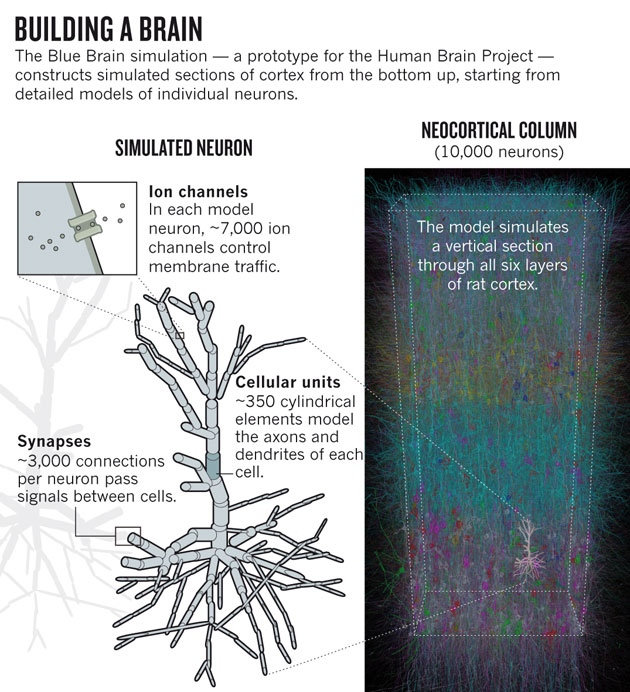
The European Commission has selected the two research proposals it will fund to the tune of half-a-billion euros each after a two-year, high-profile contest. The Human Brain Project, led by neuroscientist Henry Markram at the Swiss Federal Institute of Technology (EPFL) in Lausanne, plans to simulate everything known about the human brain in a supercomputer — a breathtaking ambition that has been met with some scepticism (See “Brain in a box”).

NATURE | BREAKING NEWS, 23 January 2013
Nature 482, 456–458 (23 February 2012) doi:10.1038/482456a


Sunday, January 20, 2013

Grid cells require excitatory drive from the hippocampus

To determine how hippocampal backprojections influence spatially periodic firing in grid cells, the author recorded neural activity in the medial entorhinal cortex (MEC) of rats after temporary inactivation of the hippocampus. They report two major changes in entorhinal grid cells. First, hippocampal inactivation gradually and selectively extinguished the grid pattern. Second, the same grid cells that lost their grid fields acquired substantial tuning to the direction of the rat's head. This transition in firing properties was contingent on a drop in the average firing rate of the grid cells and could be replicated by the removal of an external excitatory drive in an attractor network model in which grid structure emerges by velocity-dependent translation of activity across a network with inhibitory connections. These results point to excitatory drive from the hippocampus, and possibly other regions, as one prerequisite for the formation and translocation of grid patterns in the MEC.

Tora Bonnevie, et al.
Nature Neuroscience (2013) doi:10.1038/nn.3311, Published online 20 January 2013


Thursday, January 17, 2013

Human brain evolution: transcripts, metabolites and their regulators

What evolutionary events led to the emergence of human cognition? Although the genetic differences separating modern humans from both non-human primates (for example, chimpanzees) and archaic hominins (Neanderthals and Denisovans) are known, linking human-specific mutations to the cognitive phenotype remains a challenge.  The new strategy is to focus on human-specific changes at the level of intermediate phenotypes, such as gene expression and metabolism, in conjunction with evolutionary changes in gene regulation involving transcription factors, microRNA and proximal regulatory elements. In this Review the authors show how this strategy has yielded some of the first hints about the mechanisms of human cognition.


Wednesday, January 16, 2013

Light Switch Inside Brain: Laser Controls Individual Nerve Cells in Mouse

Activating and deactivating individual nerve cells in the brain is something many neuroscientists wish they could do, as it would help them to better understand how the brain works.  Scientists in Freiburg and Basel, Switzerland, have developed an implant that is able to genetically modify specific nerve cells, control them with light stimuli, and measure their electrical activity all at the same time. This novel 3-in-1 tool paves the way for completely new experiments in neurobiology.

A polymer-based neural microimplant for optogenetic applications: design and first in vivo study
Birthe Rubehn, et al.
Lab Chip, 2013, Advance Article
DOI: 10.1039/C2LC40874K, First published on the web 03 Jan 2013


Monday, January 14, 2013

Memory on time

Considerable recent work has shown that the hippocampus is critical for remembering the order of events in distinct experiences, a defining feature of episodic memory. Correspondingly, hippocampal neuronal activity can ‘replay’ sequential events in memories and hippocampal neuronal ensembles represent a gradually changing temporal context signal. Most strikingly, single hippocampal neurons – called time cells – encode moments in temporally structured experiences much as the well-known place cells encode locations in spatially structured experiences. These observations bridge largely disconnected literatures on the role of the hippocampus in episodic memory and spatial mapping, and suggest that the fundamental function of the hippocampus is to establish spatio-temporal frameworks for organizing memories.

Howard Eichenbaum
Trends in Cognitive Sciences, 14 January 2013
http://www.sciencedirect.com/science/article/pii/S1364661312002896

Sunday, January 13, 2013

Layer-specific excitatory circuits differentially control recurrent network dynamics in the neocortex

In the absence of external stimuli, the mammalian neocortex shows intrinsic network oscillations. These dynamics are characterized by translaminar assemblies of neurons whose activity synchronizes rhythmically in space and time. How different cortical layers influence the formation of these spontaneous cellular assemblies is poorly understood. The author found that excitatory neurons in supragranular and infragranular layers have distinct roles in the regulation of intrinsic low-frequency oscillations in mice in vivo. Optogenetic activation of infragranular neurons generated network activity that resembled spontaneous events, whereas photoinhibition of these same neurons substantially attenuated slow ongoing dynamics. In contrast, light activation and inhibition of supragranular cells had modest effects on spontaneous slow activity. This study represents, to the best of our knowledge, the first causal demonstration that excitatory circuits located in distinct cortical layers differentially control spontaneous low-frequency dynamics.

Riccardo Beltramo,  et al.
Nature Neuroscience (2013) doi:10.1038/nn.3306, Published online 13 January 2013


Wednesday, January 9, 2013

Feedback Inhibition Enables Theta-Nested Gamma Oscillations and Grid Firing Fields

Cortical circuits are thought to multiplex firing rate codes with temporal codes that rely on oscillatory network activity, but the circuit mechanisms that combine these coding schemes are unclear. The authors establish with optogenetic activation of layer II of the medial entorhinal cortex that theta frequency drive to this circuit is sufficient to generate nested gamma frequency oscillations in synaptic activity. These nested gamma oscillations closely resemble activity during spatial exploration, are generated by local feedback inhibition without recurrent excitation, and have clock-like features suitable as reference signals for multiplexing temporal codes within rate-coded grid firing fields. In network models deduced from our data, feedback inhibition supports coexistence of theta-nested gamma oscillations with attractor states that generate grid firing fields. These results indicate that grid cells communicate primarily via inhibitory interneurons. This circuit mechanism enables multiplexing of oscillation-based temporal codes with rate-coded attractor states.

Hugh Pastoll, et al.
Neuron, Volume 77, Issue 1, 141-154, 9 January 2013, 10.1016/j.neuron.2012.11.032


Eliminating Useless Information Important to Learning, Making New Memories

As we age, it just may be the ability to filter and eliminate old information -- rather than take in the new stuff -- that makes it harder to learn, scientists report.  "When you are young, your brain is able to strengthen certain connections and weaken certain connections to make new memories," said Dr. Joe Z. Tsien, neuroscientist at Georgia Regents University.  It's that critical weakening that appears hampered in the older brain, according to a study in the journalScientific Reports.

The NMDA receptor in the brain's hippocampus is like a switch for regulating learning and memory, working through subunits called NR2A and NR2B. NR2B is expressed in higher percentages in children, enabling neurons to talk a fraction of a second longer; make stronger bonds, called synapses; and optimize learning and memory. This formation of strong bonds is called long-term potentiation. The ratio shifts after puberty, so there is more NR2A and slightly reduced communication time between neurons.  When Tsien and his colleagues genetically modified mice that mimic the adult ratio -- more NR2A, less NR2B -- they were surprised to find the rodents were still good at making strong connections and short-term memories but had an impaired ability to weaken existing connections, called long-term depression, and to make new long-term memories as a result. It's called information sculpting and adult ratios of NMDA receptor subunits don't appear to be very good at it.
Science Daily, Jan 9, 2012 
Zhenzhong Cui, et al
Scientific Reports 3, Article number: 1036 doi:10.1038/srep01036


Friday, January 4, 2013

New Information on Autism and Genetics

Research out of the George Washington University reveals another piece of the puzzle in a genetic developmental disorder that causes behavioral diseases such as autism.
"It tell us that in very early development, those with 22q11.2 deletion syndrome do not make enough cells in one case, and do not put the other cells in the right place. This occurs not because of some degenerative change, but because the mechanisms that make these cells and put them in the right place during the first step of development have gone awry due to mutation,"said LaMantia.
Science Daily - Jan. 3, 2013
T. M. Maynard, et.al.
A comprehensive analysis of 22q11 gene expression in the developing and adult brain. 
Proceedings of the National Academy of Sciences, 2003; 100 (24): 14433 DOI:10.1073/pnas.2235651100


Thursday, January 3, 2013

Your Brain On Big Bird: Sesame Street Helps to Reveal Patterns of Neural Development

Using brain scans of children and adults watching Sesame Street, cognitive scientists are learning how children's brains change as they develop intellectual abilities like reading and math,
Scientists are just beginning to use brain imaging to understand how humans process thought during real-life experiences. For example, researchers have compared scans of adults watching an entertaining movie to see if neural responses are similar across different individuals. "But this is the first study to use the method as a tool for understanding development," says lead author Jessica Cantlon, an assistant professor in brain and cognitive sciences at the University of Rochester.
Cantlon JF, Li R.
Neural Activity during Natural Viewing of Sesame Street Statistically Predicts Test Scores in Early Childhood. 
PLoS Biol, 2013; 11(1): e1001462 DOI:10.1371/journal.pbio.1001462


Wednesday, December 26, 2012

A cellular mechanism for cortical associations: an organizing principle for the cerebral cortex

A basic feature of intelligent systems such as the cerebral cortex is the ability to freely associate aspects of perceived experience with an internal representation of the world and make predictions about the future. Here, a hypothesis is presented that the extraordinary performance of the cortex derives from an associative mechanism built in at the cellular level to the basic cortical neuronal unit: the pyramidal cell. The mechanism is robustly triggered by coincident input to opposite poles of the neuron, is exquisitely matched to the large- and fine-scale architecture of the cortex, and is tightly controlled by local microcircuits of inhibitory neurons targeting subcellular compartments. This article explores the experimental evidence and the implications for how the cortex operates.

Matthew Larkum
Trends in Neurosciences, 26 December 2012
10.1016/j.tins.2012.11.006


Sunday, December 23, 2012

Neuronal reference frames for social decisions in primate frontal cortex

Steve Chang et. al. studied encoding of the outcomes of social decisions in three frontal cortical areas as monkeys performed a social reward allocation task. Orbitofrontal cortex neurons signaled received rewards, anterior cingulate (ACC) sulcus neurons signaled foregone rewards, and the ACC gyrus was involved in the computation of shared experience and social reward.
Nature Neuroscience (2012) doi:10.1038/nn.3287

Thursday, December 20, 2012

Like Math? Thank Your Motivation, Not IQ

It's not how smart students are but how motivated they are and how they study that determines their growth in math achievement. That's the main finding of a new study that appears in the journal Child Development.

The study was conducted by researchers at the University of Munich and the University of Bielefeld. "While intelligence as assessed by IQ tests is important in the early stages of developing mathematical competence, motivation and study skills play a more important role in students' subsequent growth," according to Kou Murayama, postdoctoral researcher of psychology at the University of California, Los Angeles (who was at the University of Munich when he led the study).

Science Daily Dec. 20, 2012
Scientific American Dec 28, 2012

Kou Murayama, et. al.
Predicting Long-Term Growth in Students' Mathematics Achievement: The Unique Contributions of Motivation and Cognitive Strategies.
Child Development, 20 DEC 2012 DOI: 10.1111/cdev.12036

Sunday, December 16, 2012

Woman With Quadriplegia Feeds Herself Chocolate Using Mind-Controlled Robot Arm

Reaching out to high five someone, grasping and moving objects of different shapes and sizes, feeding herself dark chocolate. For Jan Scheuermann and a team of researchers from the University of Pittsburgh School of Medicine and UPMC, accomplishing these seemingly ordinary tasks demonstrated for the first time that a person with longstanding quadriplegia can maneuver a mind-controlled, human-like robot arm in seven dimensions (7D) to consistently perform many of the natural and complex motions of everyday life.
UPMC/University of Pittsburgh Schools of the Health Sciences, News release on Dec 16, 2012

Monday, December 10, 2012

Evolution of GluN2A/B cytoplasmic domains diversified vertebrate synaptic plasticity and behavior

Understanding the mechanisms underlying the many forms of vertebrate behavior is a central objective of neuroscience and, although studied extensively at the cellular and circuit levels, very little is known about the underlying molecular evolutionary events. How did genome evolution give rise to the many forms of learning, emotional behavior and motor functions and generate the subtlety of synaptic regulation that is manifest in the mammalian brain?

Two genome duplications early in the vertebrate lineage expanded gene families, including GluN2 subunits of the NMDA receptor. Diversification between the four mammalian GluN2 proteins occurred primarily at their intracellular C-terminal domains (CTDs). To identify shared ancestral functions and diversified subunit-specific functions, the authors exchanged the exons encoding the GluN2A (also known as Grin2a) and GluN2B (also known as Grin2b) CTDs in two knock-in mice and analyzed the mice's biochemistry, synaptic physiology, and multiple learned and innate behaviors. The eight behaviors were genetically separated into four groups, including one group comprising three types of learning linked to conserved GluN2A/B regions. In contrast, the remaining five behaviors exhibited subunit-specific regulation. GluN2A/B CTD diversification conferred differential binding to cytoplasmic MAGUK proteins and differential forms of long-term potentiation. These data indicate that vertebrate behavior and synaptic signaling acquired increased complexity from the duplication and diversification of ancestral GluN2 genes.


Sunday, December 9, 2012

Neurogliaform cells dynamically regulate somatosensory integration via synapse-specific modulation

Despite the prevailing idea that neurogliaform cells produce a spatially unrestricted widespread inhibition, the authors demonstrate here that their activity attenuates thalamic-evoked feed-forward inhibition in layer IV barrel cortex but has no effect on feed-forward excitation. The result of this circuit selectivity is a dynamic regulation in the temporal window for integration of excitatory thalamic input, thus revealing a new role for neurogliaform cells in shaping sensory processing.
Ramesh Chittajallu, Kenneth A Pelkey & Chris J McBain


Sunday, December 2, 2012

Synaptic scaffold evolution generated components of vertebrate cognitive complexity

The origins and evolution of higher cognitive functions, including complex forms of learning, attention and executive functions, are unknown. A potential mechanism driving the evolution of vertebrate cognition early in the vertebrate lineage (550 million years ago) was genome duplication and subsequent diversification of postsynaptic genes. Here the authors report the first genetic analysis of a vertebrate gene family in cognitive functions measured using computerized touchscreens. Comparison of mice carrying mutations in each of the four Dlg paralogs showed that simple associative learning required Dlg4, whereas Dlg2 and Dlg3 diversified to have opposing functions in complex cognitive processes. Exploiting the translational utility of touchscreens in humans and mice, testing Dlg2 mutations in both species showed that Dlg2's role in complex learning, cognitive flexibility and attention has been highly conserved over 100 million years. Dlg-family mutations underlie psychiatric disorders, suggesting that genome evolution expanded the complexity of vertebrate cognition at the cost of susceptibility to mental illness.
Jess Nithianantharajah, et al.
Nature Neuroscience 16, 16–24 (2013) doi:10.1038/nn.3276

Sunday, November 25, 2012

Long-term modification of cortical synapses improves sensory perception

Synapses and receptive fields of the cerebral cortex are plastic. However, changes to specific inputs must be coordinated within neural networks to ensure that excitability and feature selectivity are appropriately configured for perception of the sensory environment. The authors induced long-lasting enhancements and decrements to excitatory synaptic strength in rat primary auditory cortex by pairing acoustic stimuli with activation of the nucleus basalis neuromodulatory system.

Here they report that these synaptic modifications were approximately balanced across individual receptive fields, conserving mean excitation while reducing overall response variability. Decreased response variability should increase detection and recognition of near-threshold or previously imperceptible stimuli. They confirmed both of these hypotheses in behaving animals. Thus, modification of cortical inputs leads to wide-scale synaptic changes, which are related to improved sensory perception and enhanced behavioral performance.
Robert C Froemke, et al.


Sunday, November 18, 2012

A prefrontal cortex–brainstem neuronal projection that controls response to behavioural challenge

The prefrontal cortex (PFC) is thought to participate in high-level control of the generation of behaviours (including the decision to execute actions); indeed, imaging and lesion studies in human beings have revealed that PFC dysfunction can lead to either impulsive states with increased tendency to initiate action, or to amotivational states characterized by symptoms such as reduced activity, hopelessness and depressed mood. Considering the opposite valence of these two phenotypes as well as the broad complexity of other tasks attributed to PFC, the authors sought to elucidate the PFC circuitry that favours effortful behavioural responses to challenging situations. Here they develop and use a quantitative method for the continuous assessment and control of active response to a behavioural challenge, synchronized with single-unit electrophysiology and optogenetics in freely moving rats. In recording from the medial PFC (mPFC), they observed that many neurons were not simply movement-related in their spike-firing patterns but instead were selectively modulated from moment to moment, according to the animal’s decision to act in a challenging situation. Surprisingly, they next found that direct activation of principal neurons in the mPFC had no detectable causal effect on this behavior. 

Melissa R. Warden,  et al.
Nature (2012) doi:10.1038/nature11617,  Published online 18 November 2012

Wednesday, September 12, 2012

Cross-sensory transfer of sensory-motor information: visuomotor learning affects performance on an audiomotor task, using sensory-substitution

Visual-to-auditory sensory-substitution devices allow users to perceive a visual image using sound. Using a motor-learning task, researchers in Israel found that new sensory-motor information was generalized across sensory modalities. They imposed a rotation when participants reached to visual targets, and found that not only seeing, but also hearing the location of targets via a sensory-substitution device resulted in biased movements. When the rotation was removed, aftereffects occurred whether the location of targets was seen or heard. Their findings demonstrate that sensory-motor learning was not sensory-modality-specific. They conclude that novel sensory-motor information can be transferred between sensory modalities.