HESS collaboration has carried out the first measurement of the intensity of the diffuse extragalactic background light in the nearby Universe, a fog of photons that has filled the Universe ever since its formation. Using some of the brightest gamma-ray sources in the southern hemisphere, the study was carried out using measurements performed by the HESS telescope array, located in Namibia and involving CNRS and CEA. The study is complementary to that recently carried out by the Fermi-LAT space observatory. These findings provide new insight into the size of the Universe observable in gamma rays and shed light on the formation of stars and the evolution of galaxies. Science Daily, Jan 19, 2013
A. Abramowski et al.
Measurement of the extragalactic background light imprint on the spectra of the brightest blazars observed with H.E.S.S..
An international team of astronomers, led by academics from the University of Central Lancashire (UCLan), has found the largest known structure in the universe. The large quasar group (LQG) is so large that it would take a vehicle travelling at the speed of light some 4 billion years to cross it.
NASA-funded researchers analyzing a small meteorite that may be the first discovered from the Martian surface or crust have found it contains 10 times more water than other Martian meteorites from unknown origins.
This new class of meteorite was found in 2011 in the Sahara Desert. Designated Northwest Africa (NWA) 7034, and nicknamed "Black Beauty," it weighs approximately 11 ounces (320 grams). After more than a year of intensive study, a team of U.S. scientists determined the meteorite formed 2.1 billion years ago during the beginning of the most recent geologic period on Mars, known as the Amazonian.
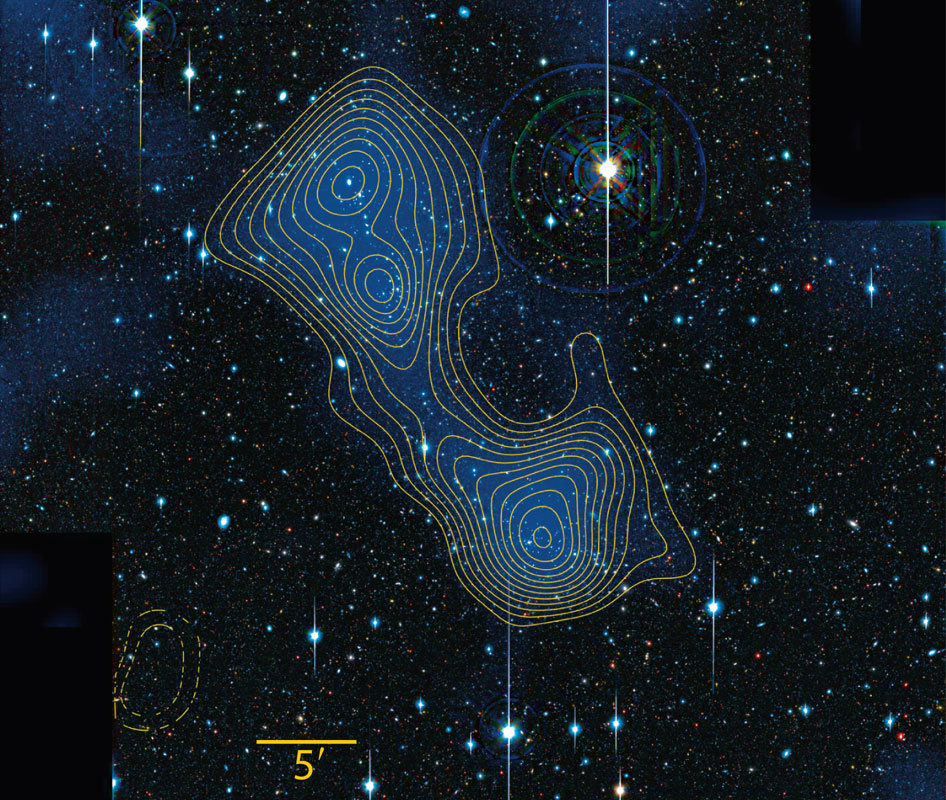
Astronomers using the NASA/ESA Hubble Space Telescope have studied a giant filament of dark matter in 3D for the first time. Extending 60 million light-years from one of the most massive galaxy clusters known, the filament is part of the cosmic web that constitutes the large-scale structure of the Universe, and is a leftover of the very first moments after the Big Bang. If the high mass measured for the filament is representative of the rest of the Universe, then these structures may contain more than half of all the mass in the Universe. Science Daily, Oct 16 2012 Nature 487, 202–204 (12 July 2012) doi:10.1038/nature11224