Showing posts with label Learning/Memory. Show all posts

Sunday, April 21, 2013

Stem Cell Transplant Restores Memory, Learning in Mice

 For the first time, human embryonic stem cells have been transformed into nerve cells that helped mice regain the ability to learn and remember.
A study at the University of Wisconsin-Madison is the first to show that human stem cells can successfully implant themselves in the brain and then heal neurological deficits, says senior author Su-Chun Zhang, a professor of neuroscience and neurology.  Once inside the mouse brain, the implanted stem cells formed two common, vital types of neurons, which communicate with the chemicals GABA or acetylcholine. "These two neuron types are involved in many kinds of human behavior, emotions, learning, memory, addiction and many other psychiatric issues," says Zhang.

Yan Liu, et al.
Medial ganglionic eminence–like cells derived from human embryonic stem cells correct learning and memory deficits. Nature Biotechnology, 2013; DOI:10.1038/nbt.2565

Friday, April 12, 2013

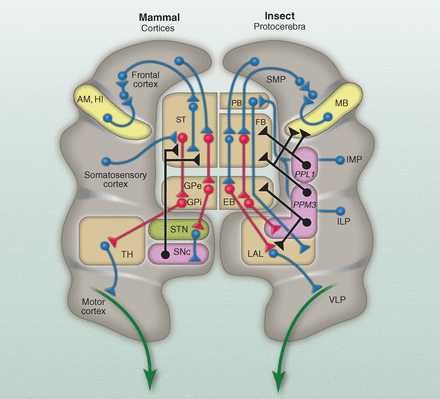
Deep Homology of Arthropod Central Complex and Vertebrate Basal Ganglia

Similarities of brain structure, function, and behavior are usually ascribed to convergent evolution. In their review, Strausfeld and Hirth (p. 157) identify multiple commonalities shared by vertebrate basal ganglia and a system of forebrain centers in arthropods called the central complex. The authors conclude that circuits essential to behavioral choice originated very early across phyla.

Nicholas J. Strausfeld, et al
Science 12 April 2013:
Vol. 340 no. 6129 pp. 157-161 , DOI: 10.1126/science.1231828

Thursday, April 11, 2013

See-through brains clarify connections

A chemical treatment that turns whole organs transparent offers a big boost to the field of ‘connectomics’ — the push to map the brain’s fiendishly complicated wiring. Scientists could use the technique to view large networks of neurons with unprecedented ease and accuracy. The technology also opens up new research avenues for old brains that were saved from patients and healthy donors.

Helen Shen
Nature 496, 151 (11 April 2013) doi:10.1038/496151a

Kwanghun Chung, et al
Structural and molecular interrogation of intact biological systems
Nature (2013) doi:10.1038/nature12107

Saturday, January 26, 2013

Developmental processes in face perception

Understanding the developmental origins of face recognition has been the goal of many studies of various approaches. Contributions of experience-expectant mechanisms (early component), like perceptual narrowing, and lifetime experience (late component) to face processing remain elusive. By investigating captive chimpanzees of varying age, a rare case of a species with lifelong exposure to non-conspecific faces at distinctive levels of experience, we can disentangle developmental components in face recognition. We found an advantage in discriminating chimpanzee above human faces in young chimpanzees, reflecting a predominant contribution of an early component that drives the perceptual system towards the conspecific morphology, and an advantage for human above chimpanzee faces in old chimpanzees, reflecting a predominant late component that shapes the perceptual system along the critical dimensions of the face exposed to. We simulate the contribution of early and late components using computational modeling and mathematically describe the underlying functions.

Christoph D. Dahl, et al.
Published 09 January 2013

Sunday, January 20, 2013

Grid cells require excitatory drive from the hippocampus

To determine how hippocampal backprojections influence spatially periodic firing in grid cells, the author recorded neural activity in the medial entorhinal cortex (MEC) of rats after temporary inactivation of the hippocampus. They report two major changes in entorhinal grid cells. First, hippocampal inactivation gradually and selectively extinguished the grid pattern. Second, the same grid cells that lost their grid fields acquired substantial tuning to the direction of the rat's head. This transition in firing properties was contingent on a drop in the average firing rate of the grid cells and could be replicated by the removal of an external excitatory drive in an attractor network model in which grid structure emerges by velocity-dependent translation of activity across a network with inhibitory connections. These results point to excitatory drive from the hippocampus, and possibly other regions, as one prerequisite for the formation and translocation of grid patterns in the MEC.

Tora Bonnevie, et al.
Nature Neuroscience (2013) doi:10.1038/nn.3311, Published online 20 January 2013


Recurrent inhibitory circuitry as a mechanism for grid formation


Grid cells in layer II of the medial entorhinal cortex form a principal component of the mammalian neural representation of space. The firing pattern of a single grid cell has been hypothesized to be generated through attractor dynamics in a network with a specific local connectivity including both excitatory and inhibitory connections. However, experimental evidence supporting the presence of such connectivity among grid cells in layer II is limited. Here we report recordings from more than 600 neuron pairs in rat entorhinal slices, demonstrating that stellate cells, the principal cell type in the layer II grid network, are mainly interconnected via inhibitory interneurons. Using a model attractor network, we demonstrate that stable grid firing can emerge from a simple recurrent inhibitory network. Our findings thus suggest that the observed inhibitory microcircuitry between stellate cells is sufficient to generate grid-cell firing patterns in layer II of the medial entorhinal cortex.

Jonathan J Couey, et al.
Nature Neuroscience (2013) doi:10.1038/nn.3310, Published online 20 January 2013


Wednesday, January 16, 2013

Light Switch Inside Brain: Laser Controls Individual Nerve Cells in Mouse

Activating and deactivating individual nerve cells in the brain is something many neuroscientists wish they could do, as it would help them to better understand how the brain works.  Scientists in Freiburg and Basel, Switzerland, have developed an implant that is able to genetically modify specific nerve cells, control them with light stimuli, and measure their electrical activity all at the same time. This novel 3-in-1 tool paves the way for completely new experiments in neurobiology.

A polymer-based neural microimplant for optogenetic applications: design and first in vivo study
Birthe Rubehn, et al.
Lab Chip, 2013, Advance Article
DOI: 10.1039/C2LC40874K, First published on the web 03 Jan 2013


Monday, January 14, 2013

Memory on time

Considerable recent work has shown that the hippocampus is critical for remembering the order of events in distinct experiences, a defining feature of episodic memory. Correspondingly, hippocampal neuronal activity can ‘replay’ sequential events in memories and hippocampal neuronal ensembles represent a gradually changing temporal context signal. Most strikingly, single hippocampal neurons – called time cells – encode moments in temporally structured experiences much as the well-known place cells encode locations in spatially structured experiences. These observations bridge largely disconnected literatures on the role of the hippocampus in episodic memory and spatial mapping, and suggest that the fundamental function of the hippocampus is to establish spatio-temporal frameworks for organizing memories.

Howard Eichenbaum
Trends in Cognitive Sciences, 14 January 2013
http://www.sciencedirect.com/science/article/pii/S1364661312002896

Wednesday, January 9, 2013

Eliminating Useless Information Important to Learning, Making New Memories

As we age, it just may be the ability to filter and eliminate old information -- rather than take in the new stuff -- that makes it harder to learn, scientists report.  "When you are young, your brain is able to strengthen certain connections and weaken certain connections to make new memories," said Dr. Joe Z. Tsien, neuroscientist at Georgia Regents University.  It's that critical weakening that appears hampered in the older brain, according to a study in the journalScientific Reports.

The NMDA receptor in the brain's hippocampus is like a switch for regulating learning and memory, working through subunits called NR2A and NR2B. NR2B is expressed in higher percentages in children, enabling neurons to talk a fraction of a second longer; make stronger bonds, called synapses; and optimize learning and memory. This formation of strong bonds is called long-term potentiation. The ratio shifts after puberty, so there is more NR2A and slightly reduced communication time between neurons.  When Tsien and his colleagues genetically modified mice that mimic the adult ratio -- more NR2A, less NR2B -- they were surprised to find the rodents were still good at making strong connections and short-term memories but had an impaired ability to weaken existing connections, called long-term depression, and to make new long-term memories as a result. It's called information sculpting and adult ratios of NMDA receptor subunits don't appear to be very good at it.

Science Daily, Jan 9, 2012 
Zhenzhong Cui, et al
Scientific Reports 3, Article number: 1036 doi:10.1038/srep01036


Sunday, November 25, 2012

Long-term modification of cortical synapses improves sensory perception

Synapses and receptive fields of the cerebral cortex are plastic. However, changes to specific inputs must be coordinated within neural networks to ensure that excitability and feature selectivity are appropriately configured for perception of the sensory environment. The authors induced long-lasting enhancements and decrements to excitatory synaptic strength in rat primary auditory cortex by pairing acoustic stimuli with activation of the nucleus basalis neuromodulatory system.

Here they report that these synaptic modifications were approximately balanced across individual receptive fields, conserving mean excitation while reducing overall response variability. Decreased response variability should increase detection and recognition of near-threshold or previously imperceptible stimuli. They confirmed both of these hypotheses in behaving animals. Thus, modification of cortical inputs leads to wide-scale synaptic changes, which are related to improved sensory perception and enhanced behavioral performance.
Robert C Froemke, et al.


Friday, October 12, 2012

Newborn cortical neurons: only for neonates?

Despite a century of debate over the existence of adult cortical neurogenesis, a consensus has not yet been reached. Here, we review evidence of the existence, origin, migration, and integration of neurons into the adult and neonatal cerebral cortex. We find that the lack of consensus likely stems from the low rate of postnatal cortical neurogenesis that has been observed, the fact that neurogenesis may be limited to subtypes of interneurons, and variability in other conditions, both physiological and environmental. We emphasize that neurogenesis occurs in the neonatal cortex and that neural stem cells are present into adulthood; it is possible that these progenitors are dormant, but they may be reactivated, for example, following injury.

David M. Feliciano, Angélique Bordey
Trends in Neurosciences, Volume 36, Issue 1, 51-61, 12 October 2012
10.1016/j.tins.2012.09.004


Sunday, August 26, 2012

Humans can learn new information during sleep

During sleep, humans can strengthen previously acquired memories, but whether they can acquire entirely new information remains unknown. The nonverbal nature of the olfactory sniff response, in which pleasant odors drive stronger sniffs and unpleasant odors drive weaker sniffs, allowed us to test learning in humans during sleep. Using partial-reinforcement trace conditioning, the authors paired pleasant and unpleasant odors with different tones during sleep and then measured the sniff response to tones alone during the same nights' sleep and during ensuing wake. They found that sleeping subjects learned novel associations between tones and odors such that they then sniffed in response to tones alone. Moreover, these newly learned tone-induced sniffs differed according to the odor pleasantness that was previously associated with the tone during sleep. This acquired behavior persisted throughout the night and into ensuing wake, without later awareness of the learning process. Thus, humans learned new information during sleep.

Anat Arzi, Noam Sobel et al.
Nature Neuroscience 15, 1460–1465 (2012) doi:10.1038/nn.3193
Published online 26 August 2012


Thursday, May 3, 2012

Rats Recall Past to Make Daily Decisions

 UCSF scientists have identified patterns of brain activity in the rat brain that play a role in the formation and recall of memories and decision-making. The discovery, which builds on the team's previous findings, offers a path for studying learning, decision-making and post-traumatic stress syndrome.  In the journal Science this week (online May 3, 2012), the UCSF researchers demonstrated that the brain activity is critical for memory formation and recall. Moreover, they showed that the brain patterns through which the rats see rapid replays of past experiences are fundamental to their ability to make decisions. Disturbing those particular brain patterns impaired the animals' ability to learn rules based on memories of things that had happened in the past.
Science Daily, May 3, 2012

Shantanu P. Jadhav, Caleb Kemere, P. Walter German and Loren M. Frank.
Awake Hippocampal Sharp-Wave Ripples Support Spatial Memory.
Science, May 4, 2012 DOI: 10.1126/science.1217230


Wednesday, March 14, 2012

Rats Match Humans in Decision-Making That Involves Combining Different Sensory Cues

The next time you set a trap for that rat running around in your basement, here's something to consider: you are going up against an opponent whose ability to assess the situation and make decisions is statistically just as good as yours.   A Cold Spring Harbor Laboratory (CSHL) study that compared the ability of humans and rodents to make perceptual decisions based on combining different modes of sensory stimuli -- visual and auditory cues, for instance -- has found that just like humans, rodents also combine multisensory information and exploit it in a "statistically optimal" way -- or the most efficient and unbiased way possible.
Science Daily, Mar. 13, 2012

David Raposo, et al.
Multisensory decision-making in rats and humans. Journal of Neuroscience, March 14, 2012 DOI:10.1523/JNEUROSCI.4998-11.2012

Monday, October 10, 2011

Pattern separation in the hippocampus

The ability to discriminate among similar experiences is a crucial feature of episodic memory. This ability has long been hypothesized to require the hippocampus, and computational models suggest that it is dependent on pattern separation. However, empirical data for the role of the hippocampus in pattern separation have not been available until recently. This review summarizes data from electrophysiological recordings, lesion studies, immediate-early gene imaging, transgenic mouse models, as well as human functional neuroimaging, that provide convergent evidence for the involvement of particular hippocampal subfields in this key process. We discuss the impact of aging and adult neurogenesis on pattern separation, and also highlight several challenges to linking across species and approaches, and suggest future directions for investigation.

Michael A. Yassa, Craig E.L. Stark
Trends in Neurosciences, Volume 34, Issue 10, October 2011, Pages 515–525
http://dx.doi.org/10.1016/j.tins.2011.06.006, How to Cite or Link Using DOI

Thursday, October 21, 2010

Human Brain Evolution: Harnessing the Genomics (R)evolution to Link Genes, Cognition, and Behavio

The evolution of the human brain has resulted in numerous specialized features including higher cognitive processes such as language. Knowledge of whole-genome sequence and structural variation via high-throughput sequencing technology provides an unprecedented opportunity to view human evolution at high resolution. However, phenotype discovery is a critical component of these endeavors and the use of nontraditional model organisms will also be critical for piecing together a complete picture. Ultimately, the union of developmental studies of the brain with studies of unique phenotypes in a myriad of species will result in a more thorough model of the groundwork the human brain was built upon. Furthermore, these integrative approaches should provide important insights into human diseases.

Genevieve Konopka, Daniel H. Geschwind
Neuron, 21 October, 2010 Volume 68, Issue 2