Friday, December 21, 2012

Nine-Year WMAP results announced

The model fit implies that the age of the universe is 13.772+/-0.059 Gyr, and the fit Hubble constant is H0 = 69.32+/-0.80 km/s/Mpc. Inflation is also supported: the fluctuations are adiabatic, with Gaussian random phases; the detection of a deviation of the scalar spectral index from unity reported earlier by WMAP now has high statistical significance (n_s = 0.9608+/-0.0080); and the universe is close to flat/Euclidean, Omega_k = -0.0027 (+0.0039/-0.0038).   Overall, the WMAP mission has resulted in a reduction of the cosmological parameter volume by a factor of 68,000 for the standard six-parameter LCDM model, based on CMB data alone. 
http://arxiv.org/abs/1212.5225
http://arxiv.org/abs/1212.5226


Whole-Genome Sequencing in Autism Identifies Hot Spots for De Novo Germline Mutation

An international team, led by researchers from UC San Diego,  has discovered that "random" mutations in the genome are not quite so random after all. Their study, to be published in the journal Cell on December 21, shows that the DNA sequence in some regions of the human genome is quite volatile and can mutate ten times more frequently than the rest of the genome. Genes that are linked to autism and a variety of other disorders have a particularly strong tendency to mutate.
Science Daily, Dec 20, 2012
Jacob J. Michaelson et al.
Cell, Volume 151, Issue 7, 1431-1442, 21 December 2012

How do environments talk to genes?

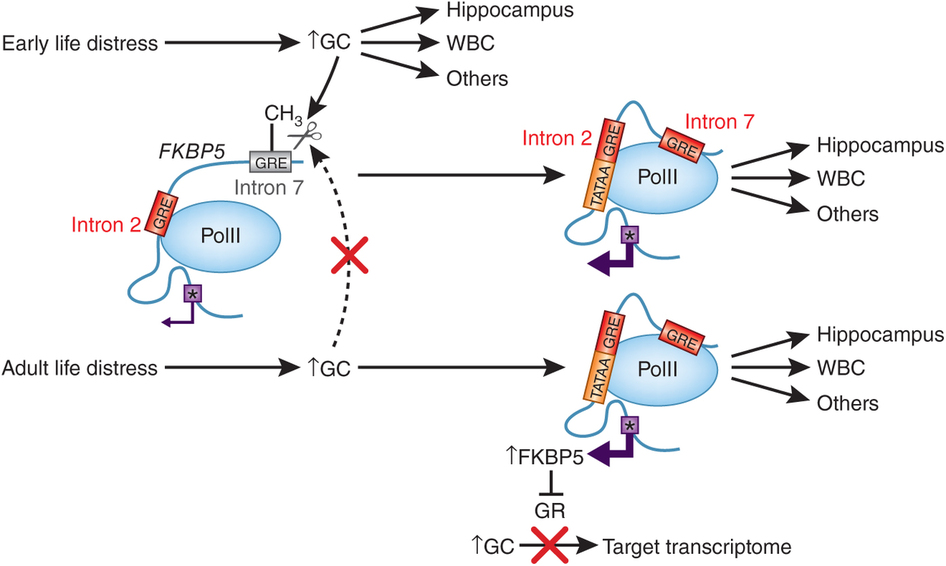
In Nature Neuroscience January 2013 issue, Moshe Szyf explains the environmental interaction onto genes. A report elucidates the widely recognized, but poorly understood, concept of gene-environment interaction, finding a molecular mechanism in the case of post-traumatic stress disorder: demethylation of a glucocorticoid response element in the stress response regulator FKBP5 that depends on both the risk allele and childhood trauma.
Moshe Szyf
Nature Neuroscience 16, 2–4 (2013) doi:10.1038/nn.3286

The ventral visual pathway: an expanded neural framework for the processing of object quality

Since the original characterization of the ventral visual pathway, our knowledge of its neuroanatomy, functional properties, and extrinsic targets has grown considerably. Here the authors synthesize this recent evidence and propose that the ventral pathway is best understood as a recurrent occipitotemporal network containing neural representations of object quality both utilized and constrained by at least six distinct cortical and subcortical systems. Each system serves its own specialized behavioral, cognitive, or affective function, collectively providing the raison d’être for the ventral visual pathway. This expanded framework contrasts with the depiction of the ventral visual pathway as a largely serial staged hierarchy culminating in singular object representations and more parsimoniously incorporates attentional, contextual, and feedback effects.

Dwight J. Kravitz, et al.
Trends in Cognitive Sciences, Volume 17, Issue 1, 26-49, 21 December 2012
10.1016/j.tics.2012.10.011


Retooling spare parts: gene duplication and cognition

Two new studies provide experimental evidence of how ancient genomic duplications of synaptic genes provided the substrate for diversification that ultimately expanded vertebrate cognitive complexity.

T Grant Belgard & Daniel H Geschwind
Nature Neuroscience 16, 6–8 (2013) doi:10.1038/nn.3292
Published online 21 December 2012


Thursday, December 20, 2012

Origin of Life: Hypothesis Traces First Protocells Back to Emergence of Cell Membrane Bioenergetics

A coherent pathway -- which starts from no more than rocks, water and carbon dioxide and leads to the emergence of the strange bio-energetic properties of living cells -- has been traced for the first time in a major hypothesis paper in Cell this week.
Science Daily on Dec. 20, 2012
Reference : Nick Lane, William F. Martin. The Origin of Membrane Bioenergetics.
Cell, 2012; 151 (7): 1406


6th Symposium on Large TPCs at Paris on Dec 17-19, 2012

SIXTH SYMPOSIUM ON LARGE TPCs FOR LOW ENERGY RARE EVENT DETECTION
at PARIS 13ème, France on December 17-19, 2012
http://www-tpc-paris.cea.fr
Presentations are posted under "Slides".

Like Math? Thank Your Motivation, Not IQ

It's not how smart students are but how motivated they are and how they study that determines their growth in math achievement. That's the main finding of a new study that appears in the journal Child Development.

The study was conducted by researchers at the University of Munich and the University of Bielefeld. "While intelligence as assessed by IQ tests is important in the early stages of developing mathematical competence, motivation and study skills play a more important role in students' subsequent growth," according to Kou Murayama, postdoctoral researcher of psychology at the University of California, Los Angeles (who was at the University of Munich when he led the study).

Science Daily Dec. 20, 2012
Scientific American Dec 28, 2012

Kou Murayama, et. al.
Predicting Long-Term Growth in Students' Mathematics Achievement: The Unique Contributions of Motivation and Cognitive Strategies.
Child Development, 20 DEC 2012 DOI: 10.1111/cdev.12036

Wednesday, December 19, 2012

Astronomers detect nearest Earth-like neighbour

Scientists have been surprised by the unexpected discovery of a nearby solar system using a new experimental technique.  The system of five planets ranging in size from two to six times the Earth's mass orbiting the Sun-like star Tau Ceti, just 12 light years away.
ABC News
http://arxiv.org/abs/1212.4058

Tuesday, December 18, 2012

Evolution: Genomic pacemakers or ticking clocks?

Although different genes evolve at different rates, when complete sets of orthologous genes are considered across taxa, the distribution of rates is remarkably conserved. That is, the differences in the rates of evolution among genes in a genome remain consistent. A potential explanation for this observation is the molecular clock, which is a model that has been used widely in phylogenetics. Now, Koonin and colleagues show that available phylogenetic data are more compatible with an alternative model that they propose termed the universal pacemaker (UPM).
Snir S, Wolf YI, Koonin EV.
PLoS Comput Biol. 
2012 Nov;8(11):e1002785. doi: 10.1371/journal.pcbi.1002785