Sunday, November 18, 2012

A prefrontal cortex–brainstem neuronal projection that controls response to behavioural challenge

The prefrontal cortex (PFC) is thought to participate in high-level control of the generation of behaviours (including the decision to execute actions); indeed, imaging and lesion studies in human beings have revealed that PFC dysfunction can lead to either impulsive states with increased tendency to initiate action, or to amotivational states characterized by symptoms such as reduced activity, hopelessness and depressed mood. Considering the opposite valence of these two phenotypes as well as the broad complexity of other tasks attributed to PFC, the authors sought to elucidate the PFC circuitry that favours effortful behavioural responses to challenging situations. Here they develop and use a quantitative method for the continuous assessment and control of active response to a behavioural challenge, synchronized with single-unit electrophysiology and optogenetics in freely moving rats. In recording from the medial PFC (mPFC), they observed that many neurons were not simply movement-related in their spike-firing patterns but instead were selectively modulated from moment to moment, according to the animal’s decision to act in a challenging situation. Surprisingly, they next found that direct activation of principal neurons in the mPFC had no detectable causal effect on this behavior. 

Melissa R. Warden,  et al.
Nature (2012) doi:10.1038/nature11617,  Published online 18 November 2012

Friday, November 16, 2012

Evolution of genetic and genomic features unique to the human lineage

Given the unprecedented tools that are now available for rapidly comparing genomes, the identification and study of genetic and genomic changes that are unique to our species have accelerated, and we are entering a golden age of human evolutionary genomics. Here the authors provide an overview of these efforts, highlighting important recent discoveries, examples of the different types of human-specific genomic and genetic changes identified, and salient trends, such as the localization of evolutionary adaptive changes to complex loci that are highly enriched for disease associations. Finally, they discuss the remaining challenges, such as the incomplete nature of current genome sequence assemblies and difficulties in linking human-specific genomic changes to human-specific phenotypic traits.

Majesta O'Bleness, et al.
Nature Reviews Genetics 13, 853-866 (December 2012) |doi:10.1038/nrg3336

Neutralino excluded up to ~250 GeV

The neutralino is excluded up to ~250 GeV.
At the
Hadron Collider Physics Symposium 2012 hosted by Kyoto University,
the new
CMS results were reported.

Higgs results updated with 7 sigma

Significance of Higgs particle has been up to 7 sigma now.
The
Hadron Collider Physics Symposium 2012 hosted by Kyoto University,
The new
CMS results were reported.

Tuesday, October 30, 2012

Studying genomic processes at the single-molecule level: introducing the tools and applications

To understand genomic processes such as transcription, translation or splicing, we need to be able to study their spatial and temporal organization at the molecular level. Single-molecule approaches provide this opportunity, allowing researchers to monitor molecular conformations, interactions or diffusion quantitatively and in real time in purified systems and in the context of the living cell. This Review introduces the types of application of single-molecule approaches that can enhance our understanding of genome function.


Friday, October 26, 2012

New South Pole Telescope shows Omaga = 1.006 +- 0.004

The South Pole Telescope published the new results.
Omega_K=-0.003+0.014-0.018. Using the SPT+WMAP7 data, the spectral index of scalar fluctuations tis ns=0.9623+/-0.0097 in the LCDM model, a 3.9sigma preference for a scale-dependent spectrum with ns<1.

Tuesday, October 16, 2012

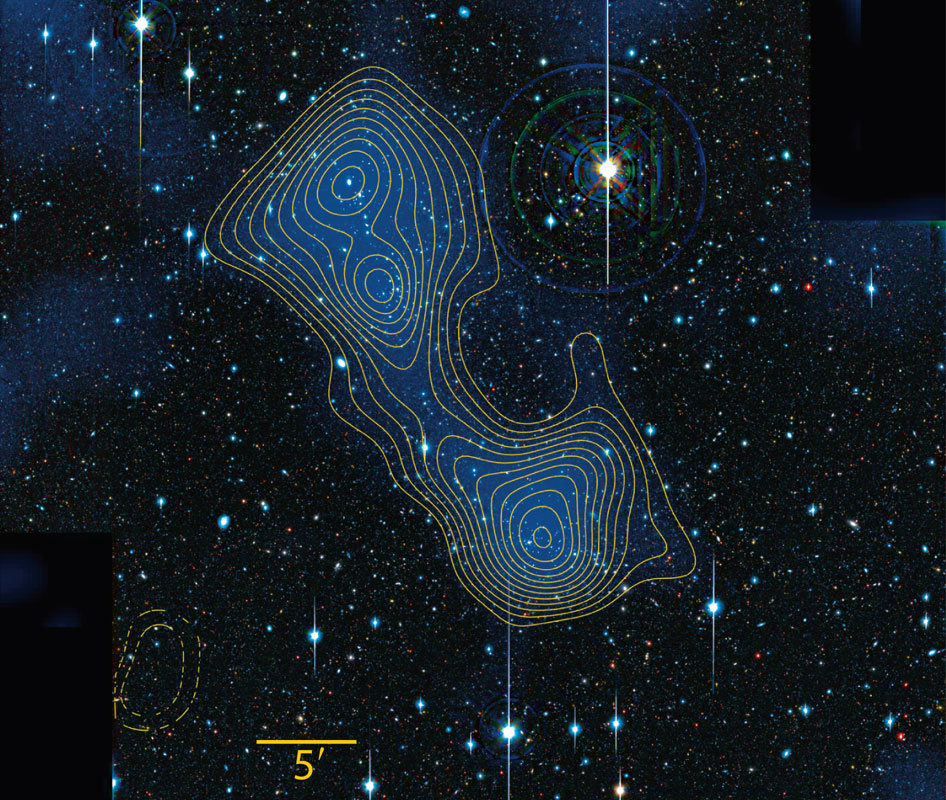
Dark Matter Filament Studied in 3-D for the First Time

Astronomers using the NASA/ESA Hubble Space Telescope have studied a giant filament of dark matter in 3D for the first time. Extending 60 million light-years from one of the most massive galaxy clusters known, the filament is part of the cosmic web that constitutes the large-scale structure of the Universe, and is a leftover of the very first moments after the Big Bang. If the high mass measured for the filament is representative of the rest of the Universe, then these structures may contain more than half of all the mass in the Universe.
Science Daily, Oct 16 2012
Nature 487, 202–204 (12 July 2012) doi:10.1038/nature11224


Friday, October 12, 2012

Newborn cortical neurons: only for neonates?

Despite a century of debate over the existence of adult cortical neurogenesis, a consensus has not yet been reached. Here, we review evidence of the existence, origin, migration, and integration of neurons into the adult and neonatal cerebral cortex. We find that the lack of consensus likely stems from the low rate of postnatal cortical neurogenesis that has been observed, the fact that neurogenesis may be limited to subtypes of interneurons, and variability in other conditions, both physiological and environmental. We emphasize that neurogenesis occurs in the neonatal cortex and that neural stem cells are present into adulthood; it is possible that these progenitors are dormant, but they may be reactivated, for example, following injury.

David M. Feliciano, Angélique Bordey
Trends in Neurosciences, Volume 36, Issue 1, 51-61, 12 October 2012
10.1016/j.tins.2012.09.004


Wednesday, October 3, 2012

Optimization of a GCaMP Calcium Indicator for Neural Activity Imaging

Genetically encoded calcium indicators (GECIs) are powerful tools for systems neuroscience. Recent efforts in protein engineering have significantly increased the performance of GECIs. The state-of-the art single-wavelength GECI, GCaMP3, has been deployed in a number of model organisms and can reliably detect three or more action potentials in short bursts in several systems in vivo.
Akerboom J et al.
J Neurosci. 2012 Oct 3;32(40):13819-40. doi: 10.1523/JNEUROSCI.2601-12.2012.

Tian L et al.
Imaging neural activity in worms, flies and mice with improved GCaMP calcium indicators.
Nat Methods. 2009 Dec;6(12):875-81. doi: 10.1038/nmeth.1398. Epub 2009 Nov 8.

Monday, October 1, 2012

Genetically encoded optical indicators for the analysis of neuronal circuits

In a departure from previous top-down or bottom-up strategies used to understand neuronal circuits, many forward-looking research programs now place the circuit itself at their centre. This has led to an emphasis on the dissection and elucidation of neuronal circuit elements and mechanisms, and on studies that ask how these circuits generate behavioural outputs. This movement towards circuit-centric strategies is progressing rapidly as a result of technological advances that combine genetic manipulation with light-based methods. The core tools of these new approaches are genetically encoded optical indicators and actuators that enable non-destructive interrogation and manipulation of neuronal circuits in behaving animals with cellular-level precision. This Review examines genetically encoded reporters of neuronal function and assesses their value for circuit-oriented neuroscientific investigations.

Thomas Knöpfel
Nature Reviews Neuroscience 13, 687-700 (October 2012) | doi:10.1038/nrn3293